FreqMoE block: average frequency fits
How it works
Method maturity: experimental. Implementation: python.
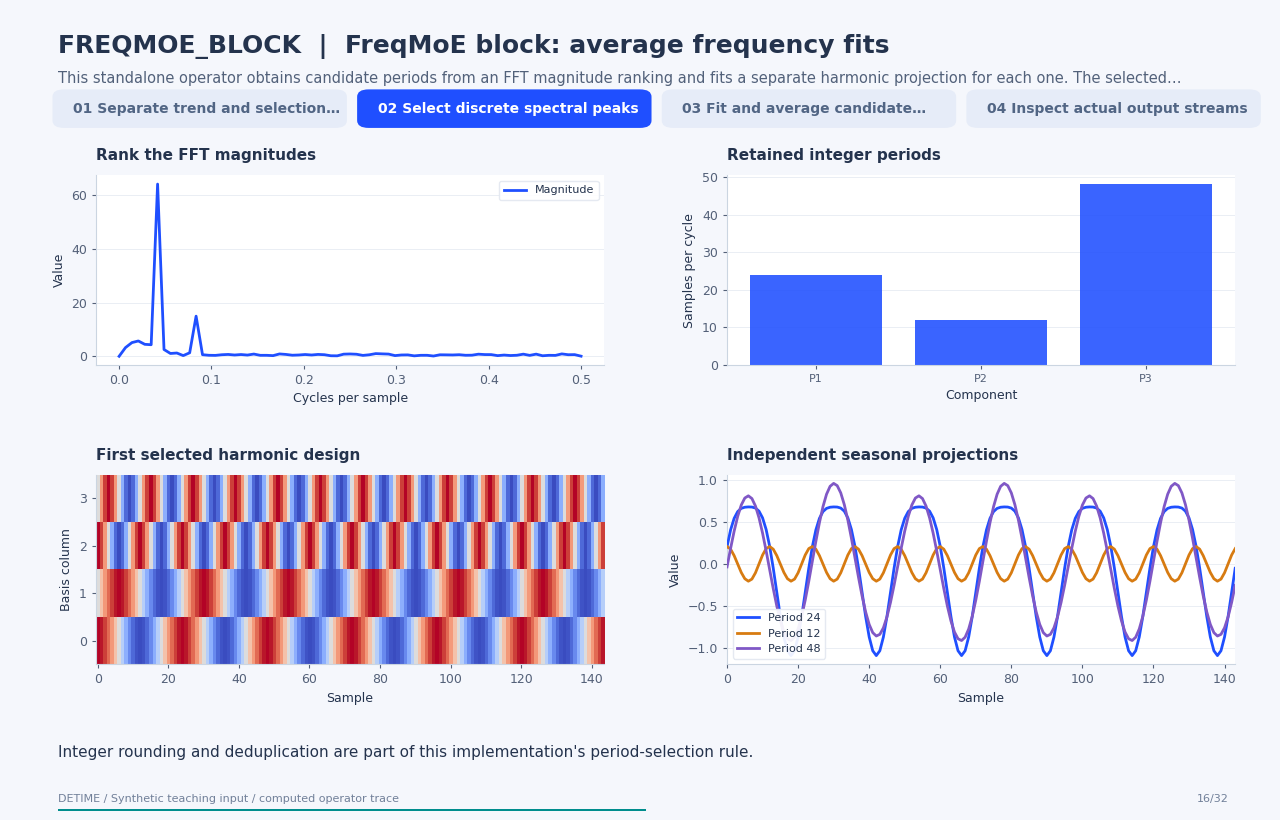
This standalone operator obtains candidate periods from an FFT magnitude ranking and fits a separate harmonic projection for each one. The selected seasonal estimate is their equal-weight average. The frames expose the selection signal, rounded periods, candidate curves and averaging operation. The parameter expert_width determines the harmonic count by rounding expert_width / 64. It does not size a fitted mixture-of-experts network here.
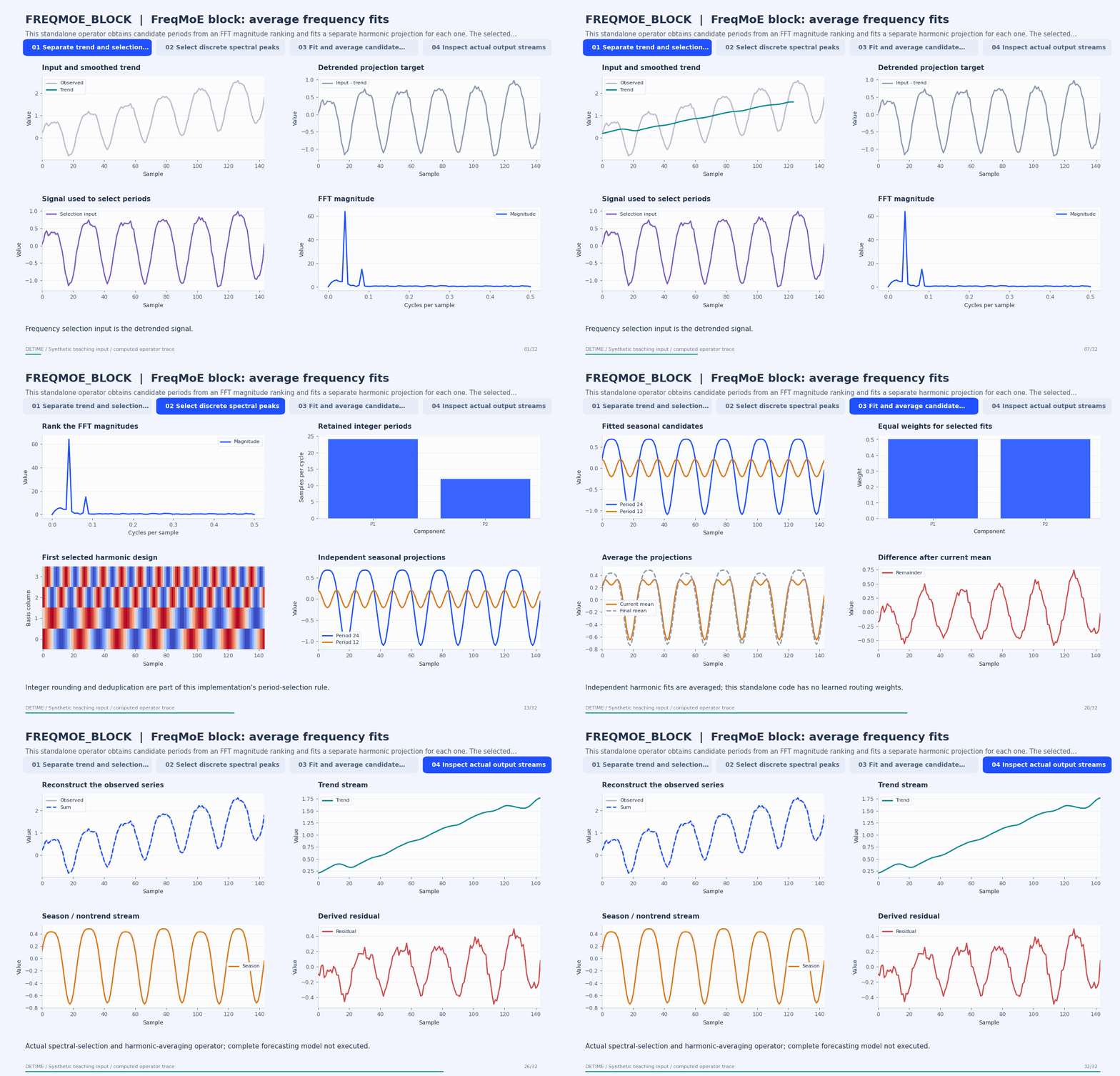
Deterministic synthetic teaching signal; not a benchmark.
Open GIF · Static PNG · Source arrays (NPZ) · Trace metadata
Follow the four steps
1. Separate trend and selection input
Compute the moving-average trend. FreqMoE selects frequencies from the detrended signal; Times2D selects them from the original signal after mean removal.
2. Select discrete spectral peaks
Rank FFT magnitudes, convert bin positions into rounded integer periods, and retain distinct periods as implemented.
3. Fit and average candidate seasons
Fit a harmonic projection of the detrended signal for each selected period, then take the arithmetic mean of these projections.
4. Inspect actual output streams
The final trend, averaged projection and derived residual are checked against the public registered operator.
Parameters that change the result
| Parameter | Effect on the computation |
|---|---|
trend_window |
Sets the centered moving-average trend. |
num_bands |
Controls how many distinct rounded FFT periods are retained. |
expert_width |
Sets harmonic capacity through round(expert_width / 64). |
fit_scope |
Explicitly full in this animation; prefix settings restrict the fitting interval. |
What this animation computes
Intermediate arrays are computed with the implemented operator helpers. The final trend, season and residual are checked against public decompose(). The animation explains this standalone experimental block; its source architecture is cited for provenance.
Interpretation
- The parameter expert_width determines the harmonic count by rounding expert_width / 64. It does not size a fitted mixture-of-experts network here.
- A large FFT bin need not correspond to a stable physical oscillation. Trends, finite windows and rounding affect the selected periods.
- The independent candidate projections are averaged, rather than jointly fitted as one combined design.
- All coefficients use the selected fitting interval; no held-out forecast accuracy is shown.
Try the method
Use this configuration with DecompositionConfig and decompose. The animation generator supplies the teaching input and records intermediate arrays.
{
  "method": "FREQMOE_BLOCK",
  "params": {
    "primary_period": 24,
    "trend_window": 49,
    "fit_scope": "full",
    "num_bands": 3,
    "expert_width": 128
  },
  "backend": "python"
}
See the configuration reference for the full interface and optional dependencies.
Sources and reproduction
- Implemented DeTime operator
- Liu (2025), FreqMoE: Enhancing Time Series Forecasting through Frequency Decomposition Mixture of Experts
- DeTime implementation:
src/detime/methods/neural_blocks/neural_block_portfolio.py
Regenerate this animation with python scripts/generate_method_animations.py --methods FREQMOE_BLOCK.
The reproduction guide explains the environment,
numerical checks, coverage manifest, and how to inspect the stored arrays.